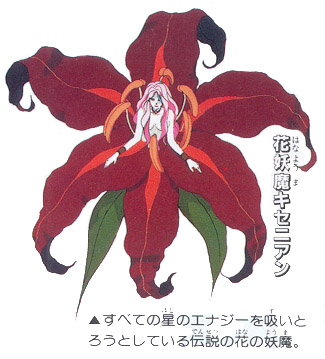
Flower Monster Xenian
[ Hana Y
 ma Kisenian]
Somewhere in the universe, Fiore finds the alien flower that is called Xenian. The two cats Luna and Artemis say that Xenian is a creature that liked to steal energy from planets. Xenian is supposedly one of the most dangerous flowers in the universe, but it can never work alone. It always needs a host. People who are weak can be used by Xenian, and their hearts and souls can be blacked by evil. In the past, Usagi gave Mamoru a flower, and Mamoru later gave that same flower to Fiore. When Fiore realizes how Mamoru received the flower, he moves away to allow the power of Usagi’s Phantom Silver Crystal (

 Maboroshi no Ginzuish) to eliminate Xenian.
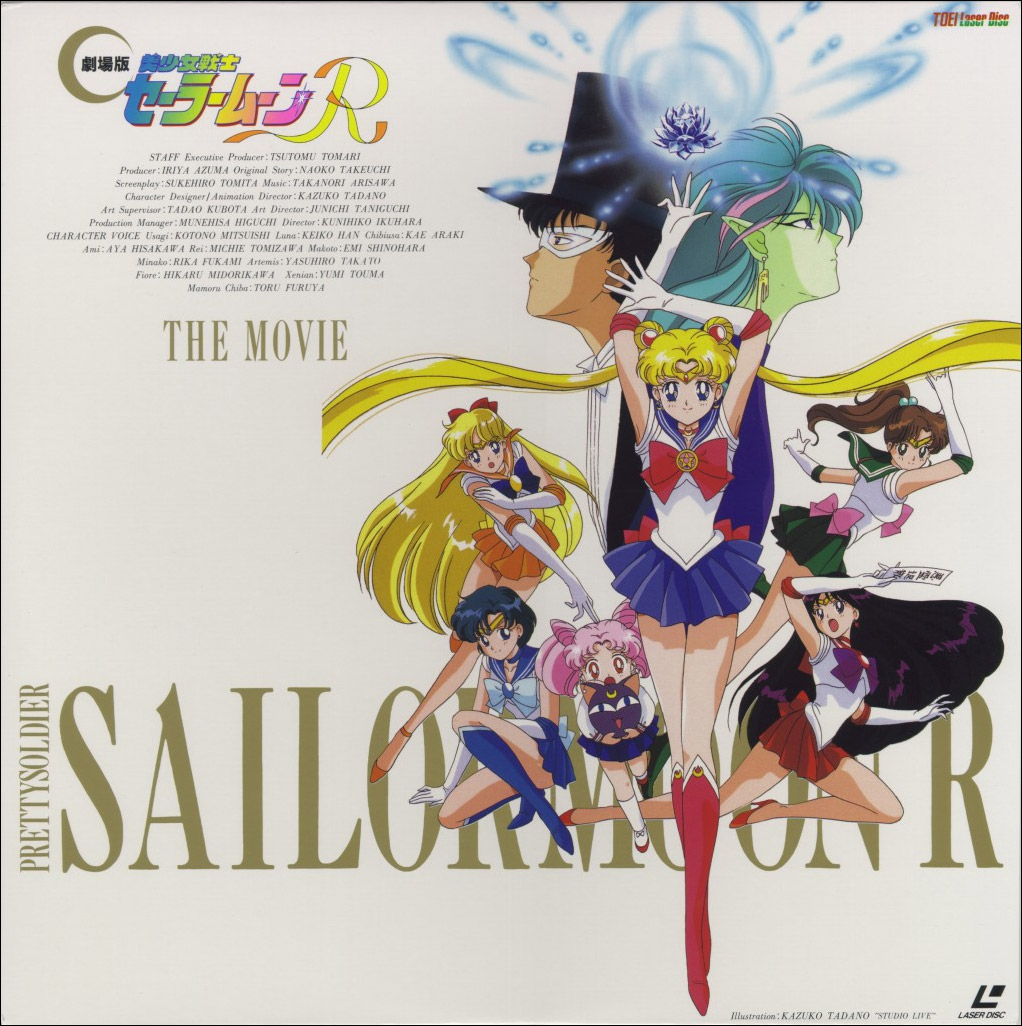
Xenian’s name appears as “Xenian” (in Roman letters) on the laser disc cover of the Japanese Bishjo Senshi S r
r M
M n R movie. Xenia most likely derives from xenia, while
  Kisenian most likely derives from
  kisenia (which approximates xenia). ( Kisenian has an extra
  n at the end.)
Notice that the  an part of Kisenian is the same as the combination used to write En’s name: An. (En is the female alien who appears in the first part of the Bishjo Senshi Sr Mn R television series.)
Xenia has several different meanings:
A flowering plant with the binomial nomenclature Anacampseros vulcanensis also has been called Xenia vulcanensis.
Dictionary.com defines xenia as the “direct effect on a hybrid plant produced by the transfer of pollen from one strain to the endosperm of a different strain.”
Xenia is also the genus name of soft corals from Indo-Pacific reefs with large flower-like polyps. The taxonomists placed those corals into the class Anthozoa (meaning flower-animal).
The Greek word xenia refers to “hospitality shown to a guest.” Barry B. Powell’s book Classical Myth offers a detailed description of xenia:
Above all, Zeus protected the custom called xenia (ksen- -a), which we can roughly translate as “a formal institution of friendship” (xenos means “guest” or “stranger,” as in English xenophobia = “fear of strangers”). Xenia enabled Greeks to travel safely to distant lands where other Greeks lived. A relationship was established when a wanderer was received into someone’s household, entertained, and given a gift. Should the host one day visit the wanderer’s home, he could expect to be received similarly. Obligations of reciprocal hospitality fell not only on the individuals involved originally, but also on their entire families and on their descendants. A host violated xenia if he killed or robbed his guest, as did a guest who stole from his host or seduced his host’s wife. The legendary Trojan Paris seduced Helen, wife of his host Menelaüs; this violation of xenia began the Trojan War and ensured Zeus’ approval of Troy’s destruction, despite his love for the city. Similarly, Homer’s Odyssey can be viewed as a study in appropriate and inappropriate expressions of xenia.
(Classical Myth: pp. 140-141.)
Xi, the first letter in the original word  (xenia) was apparently pronounced at some time like the ks in kicks rather than the z in zoo. The katakana-character combination
  kise can represent the Greek letters Xi (
 ) and Epsilon (
 ).
).  Kisenon often approximates the element name Xenon.
Xenian’s name can be thought of as a complex pun. Xenian, the wanderer ( [xenos]) flower that Fiore found while looking for a present to give to Mamoru because of the guest-friendship ( [xenia]) between the two youngsters, uses Fiore as a host.
Yumi T ma (
ma ( Tma Yumi) provided the voice for Xenian in the original Japanese version of the Bishjo Senshi Sr Mn R movie. She also provided the voice for the alien En in the first section of the Bishjo Senshi Sr Mn R series.
Another Piece of Artwork

© 2001-2008 Ian Andreas Miller. All rights reserved. Those statements refer to all of the original content on these Web pages. All of the other works that are mentioned on these pages are the properties of their authors.