|
|
|
|
Usagi is a Past Version of Sailor Cosmos
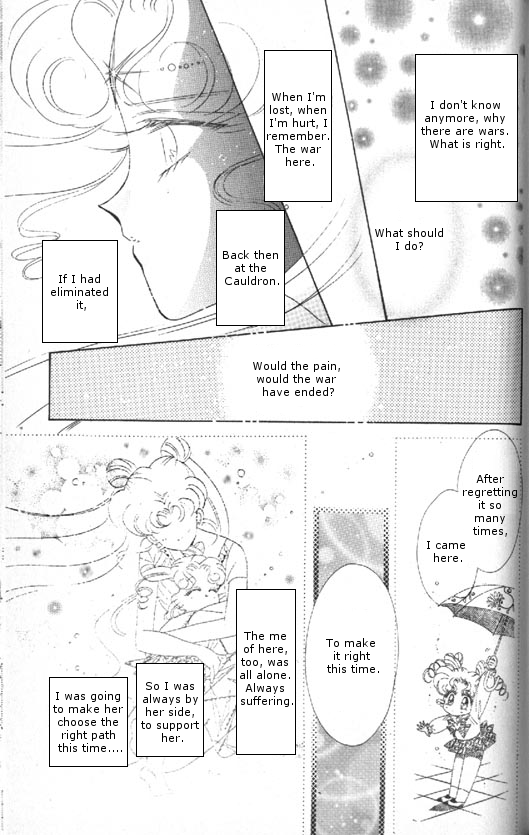
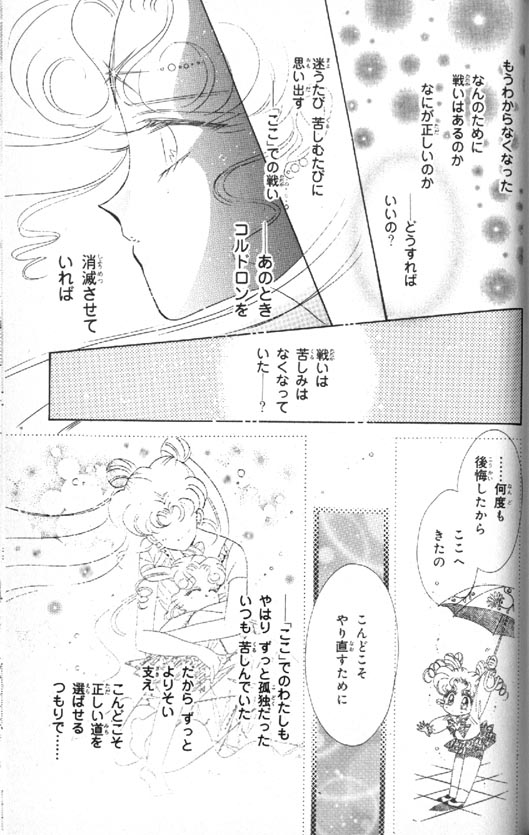
This page from the manga shows Sailor Cosmos connecting herself with Usagi:
http://www.sailormoon.ws/diesgaudii/articles/tomb/cosmos-manga.gif
Thank you, Gina, for scanning that page from the manga!
Notice that I replaced the Japanese text with English text.
Sailor Cosmos is the one who is talking on that page:
|

1: “I don't know anymore, why there are wars. What is right.
2: What should I do?
3: When I'm lost, when I'm hurt, I remember. The war here.
4: Back then at the Cauldron.
5: If I had eliminated it,
6: Would the pain, would the war have ended?
7: After regretting it so many times,
8: I came here.
9: To make it right this time.
10: The me of here, too, was all alone. Always suffering.
11: So I was always by her side, to support her.
12: I was going to make her choose the right path this time...”
|
The word spaces on the page are supposed to be read from top to bottom, and from right to left since the page came from a Japanese book.
Sailor Cosmos says, “Back then at the Cauldron. If I had eliminated it...” in one of the panels near the top of the page. As far as we know, there is not a time when Sailor Cosmos, in her Sailor Cosmos form, attempts to destroy the Cauldron. We do see Chibi Chibi trying to get Sailor Moon (Usagi) to destroy it in act 51. Furthermore, nobody else is shown to have the decision of destroying it. Chibi Chibi does not have that decision during the present time, so Sailor Cosmos’ comment here must be referring to a past version of herself who had that decision. The most likely candidate for that past version is Sailor Moon. Furthermore, Sailor Cosmos is not making a distinction among her various forms (her own present Sailor Cosmos form and her own past version). She does not call that past version “she” and her present version “I” here.
Notice the “I came here” word space that is next to the picture of Chibi Chibi. Sailor Cosmos is obviously referring to herself in her Chibi Chibi form since we see Chibi Chibi there (natch). This is a time when Sailor Cosmos is making a distinction among her various forms. That picture of Chibi Chibi came from act 44. It is part of a sequence of panels that show Chibi Chibi floating down from the sky. Later, in act 51, Sailor Moon sees Chibi Chibi transform into Sailor Cosmos. If Sailor Cosmos, in her Chibi Chibi form, arrives in Usagi’s time in act 44, and she reveals her Sailor Cosmos form in act 51, then Chibi Chibi is not a past form of Sailor Cosmos. The Chibi Chibi form is simply one that Sailor Cosmos uses when she arrives in Usagi’s (Sailor Moon’s) time. That means neither Sailor Cosmos nor her Chibi Chibi form is native to that era. Chibi Chibi is not Sailor Cosmos’ “me of here,” where the “here” refers to Usagi’s time.
The words “The me of here, too...” appear in the panel that shows a picture of Usagi and Chibi Chibi. When Sailor Cosmos says, “The me of here, too,” she is obviously making a distinction between Chibi Chibi and someone else. There is no way that she could be referring to Chibi Chibi when she says, “The me of here, too” because she just gets done referring to her Chibi Chibi form when she says, “I came here. To make it right this time.” That leaves Usagi to be the “me of here.”
The picture of Usagi and Chibi Chibi first appears in act 45 of the manga. When that scene originally happens in the manga, Chibi Chibi is the one who comes in to cheer Usagi up. That means the “So I was always by her side, to support her” word space and the picture itself shows us that Chibi Chibi is the one doing the supporting (comforting), and Usagi is receiving the support (comfort).
Here is an important question: Since when does Usagi attempt to make Chibi Chibi choose the right path this time? Never. When Chibi Chibi comforts Usagi in that picture, Usagi does not even know what happens in the future! We do not even know Sailor Cosmos’ story until she tells us! We do know that Sailor Cosmos (as Chibi Chibi) wants Sailor Moon to destroy the Cauldron because she believes that would end the pain and war. At the time that Sailor Cosmos comes to Usagi’s time, she still has the idea that destroying the Cauldron would be the right path. She does not change her mind until act 51 when Sailor Moon convinces her that things will be all right and that the good characters will never be defeated. That means that when Chibi Chibi hugs Usagi in that picture, she still thinks that destroying the Cauldron is the best thing to do. The “I” in Sailor Cosmos’ “I was going to make her choose the right path this time...” comment must refer to Chibi Chibi, and the “her” refers to Usagi. Sailor Cosmos cannot be referring to her Sailor Cosmos form because we do not see her, in that form, attempt to make Sailor Moon destroy the Cauldron.
Here is another way to think of that section in the manga:
- If Sailor Cosmos is referring to Usagi as the “I” in the panel that shows the picture of Usagi and Chibi, and Chibi Chibi is the “me of here,” then she is identifying herself with Usagi in the first person. (That would show that Sailor Cosmos is a future form of Usagi.)
- If Sailor Cosmos is referring to Chibi Chibi as the “I” in the panel that shows the picture of Usagi and Chibi Chibi (she is), and Usagi is the “me of here,” then she is identifying herself with Usagi as a past version of herself. (That would show that Sailor Cosmos is a future form of Usagi.)
- If Sailor Cosmos is not trying to identify herself with Usagi in any way in the panel that shows the picture of Chibi Chibi and Usagi, then there is no reason to show a picture of Chibi Chibi and Usagi. Usagi’s presence in the picture is a redundancy.
Of course, this analysis of the text will not convince the “explain this, explain that” crowd. I suppose that nothing short of an exact statement along the lines of “Sailor Cosmos is a form of Sailor Moon” from Ms. Takeuchi herself would make them abandon the wimpy “No conclusive evidence either way” position. Yes, we could come up with arguments “either way,” but so what? In the debate that concerns the heliocentric and geocentric models of the Solar System, there are arguments “for both sides.” One of the explanations is simply superior to the other. In the Sailor Cosmos debate, thinking that we need a direct statement from the creator herself indicates that we will not accept the evidence in the manga. One of the biggest problems in the Sailor Cosmos debate is that many fans are being bogged down by easily refuted-arguments that are not being addressed. (The “Helios versus Elios” debate also has that problem.) Weak arguments for both sides may be rejected, but the remaining arguments (whether they are actually weak or strong) seem plausible to the fans. Both sides seem to have those plausible arguments, and some fans interpret that to mean that one side is not more likely to be right than the other. However, the arguments should be judged by their strengths, not by the fact that the ideas that they convey are plausible. Since Sailor Cosmos is clearly connecting herself with Sailor Moon (Usagi), fans who say that there are arguments “either way” are simply engaging in the middle ground fallacy.
Weak Sailor Cosmos Arguments
Some fans have proposed some weak arguments about how Sailor Cosmos cannot be a future version of Sailor Moon. At the 1998 San Diego Comic-Con, someone asked Naoko Takeuchi exactly who Sailor Cosmos is. She said, “It’s complicated, but she’s essentially a future version of Sailor Moon.” Hans Schumacher, who was at the convention, pointed that out to me. He recorded the question and answer session, so we can know the answer that Ms. Takeuchi gave. So, all of these “Sailor Cosmos cannot be a future version of Sailor Moon” arguments should not be taken seriously. (The distinction between Sailor Moon and Usagi is a distinction without a difference here. Usagi is the only character who is thought of as the real Sailor Moon in the manga and anime. Sailor Chibi Moon does not officially get the title of Sailor Moon in those continuities. If there is not a good reason for us to think that Ms. Takeuchi meant to refer to another character besides Usagi when she said "Sailor Moon" at the Comic-Con, then there is no reason to think that she meant another person.) I responded to the arguments simply because I wished to show their weaknesses.
|
“Sailor Cosmos’s comment that as translated as ‘The me of here’ is better translated as ‘the me of this time.’ She is referring to the one who was in her situation, not that it was her personally. If she had have meant that she was going to make her (as in herself) make the same choice, she would have used the word watashi.”
|
Sailor Cosmos says, “Koko de no watashi...” in Japanese. “The me of here” is an acceptable translation. The Japanese words for time (toki and jikan) do not even appear in the panel in question.
|
“The ‘here’ in either translation refers to the Cauldron.”
|
There is a way to know what she means by “here.” The “here” cannot refer to just the Cauldron because the Japanese word koko (in kagi kakko, which are Japanese parentheses) also appears next to a flashback image of Chibi Chibi and Usagi. That image of Chibi Chibi and Usagi shows them back on Earth. Logically, the “here” would refer to Usagi’s time.
|
“Sailor Cosmos cannot be a future version of Sailor Moon because two of the same people cannot be in the same time and place.”
|
This argument suppresses evidence. A space-time distortion occurs when two people are in the same time and space, but the effect is not immediate. There is no known set time limit for how long it takes the space-time distortion to occur. When it occurs, it does so randomly and inconsistently. (Sailor Moon experiences a space-time distortion when she is in the future with Neo Queen Serenity, but she seems to be okay a few panels later when she is still in the future. Moreover, the other characters do not experience a space-time distortion.) Sailor Cosmos’ presence would not cause a space-time distortion if she were not in Usagi’s time long enough.
King Endymion also claims that two of the same object cannot exist in the same time. However, we see that the twentieth-century versions of the Sailor Crystals of Sailor Moon, Tuxedo Mask, and Sailor Venus can exist in the thirtieth century with their thirtieth-century counterparts. Sailor Moon cannot use her power, however, because the two versions of the Silver Crystal in the thirtieth century are affecting each other. Apparently, Sailor Venus and Tuxedo Mask can still use their powers even though two versions of each of their crystals exist in the same time. The reason for that is not known.
Prince Demand attempts to make the twentieth-century and thirtieth-century versions of the Silver Crystal touch each other. Sailor Pluto claims that if the two versions touch each other, everything in the world could be over. However, there is no indication that there is a rule that states that two or more versions of all objects cannot touch each other in the same time. Moreover, there is nothing that indicates that two versions of the same person, when they are both in the same time, cannot touch each other. (While Sailor Moon experiences time distortions when two versions of her crystal exist in a particular time, nothing is shown to happen to Sailor Venus and Tuxedo Mask when two versions of each of their crystals exist in the same time.)
|
“Sailor Cosmos cannot be a future version of Sailor Moon because she refers to Eternal Sailor Moon in the third person.”
|
At one point during the manga story, Neo Queen Serenity refers to Sailor Moon in the third person. We know that she is a future form of Sailor Moon. Yes, a future version of a character can refer to his or her past form in the third person.
|
“Sailor Cosmos cannot be a future version of Sailor Moon because she says that Sailor Moon is the true Sailor Cosmos.”
|
Sailor Moon may be the true Sailor Cosmos, but that does not show that the woman who calls herself Sailor Cosmos is not a future version of Sailor Moon. Sailor Cosmos’ being a future version of Sailor Moon and her not being the real Sailor Cosmos are not mutually exclusive. Two of the same person can have different names and different powers in different times: Sailor Moon (a powerful sailor soldier) becomes Neo Queen Serenity (who is not a sailor soldier) in the future. Sailor Cosmos says, “Eternally, I am no match for the final courage and strength of Eternal Sailor Moon.” We do not know whether a future (sailor soldier) version of Sailor Moon must have more courage and strength than Eternal Sailor Moon or not.
The old “Sailor Cosmos is a title” argument may be valid, but it says nothing about whether or not the woman who calls herself Sailor Cosmos is a future version of Sailor Moon.
|
“Sailor Cosmos cannot be a future version of Sailor Moon because she does not have the Ginzuish .” .”
|
a. The argument assumes that Sailor Cosmos must have a crystal that she calls the Ginzuish . Sailor Moon and her Super Sailor Moon form may use the Ginzuish, but the Ginzuish becomes the Silver Moon Crystal (an evolved form of the Ginzuish) in act 42 when she becomes Eternal Sailor Moon. Since Sailor Moon’s crystal can be in other forms besides the Ginzuish, and it can have different names, there is no reason to think that Sailor Cosmos must have a crystal that is called the Ginzuish. . Sailor Moon and her Super Sailor Moon form may use the Ginzuish, but the Ginzuish becomes the Silver Moon Crystal (an evolved form of the Ginzuish) in act 42 when she becomes Eternal Sailor Moon. Since Sailor Moon’s crystal can be in other forms besides the Ginzuish, and it can have different names, there is no reason to think that Sailor Cosmos must have a crystal that is called the Ginzuish.
b. The argument assumes that, even if Sailor Cosmos does need the Ginzuish, she does not have it. How do we know that she does not have it? She does not mention the Ginzuish, but that does not show that she does not have it.
|
“Sailor Cosmos cannot be a future version of Sailor Moon because Neo Queen Serenity is not a sailor soldier.”
|
This assumes that the final form of Sailor Moon is Neo Queen Serenity. Neo Queen Serenity may not be a sailor soldier, but there is no reason to think that she cannot be a sailor soldier again.
[Go back to Sailor Cosmos]
© 2002-2008 Ian Andreas Miller. All rights reserved. Those statements refer to all of the original content on these Web pages. All of the other works that are mentioned on these pages are the properties of their authors.
|
|
|
|
|