Ian Andreas Miller. 6 October 2002.
In volume seventeen of the
Bish jo Senshi S
 r
r M
M n
n manga, Princess
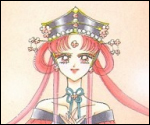
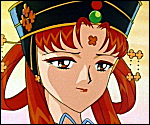
Kaky †
† says that she came from the Tankei Kingdom of the planet Kinmoku. The incense burner that held
Kaky’s body gives off the scent of fragrant olives. There is a special connection between
Kaky's fragrant olive theme and the name of her planet. Some English-speaking fans may have trouble understanding the connection without a thorough explanation. This article explains the connection.
The Japanese term  Kinmokusei refers to a variety of fragrant olive trees. That variety's scientific name is Osmanthus fragrans variation aurantiacus (“orange-red fragrant olive”)1. The term
  Kinmoku-sei means planet Kinmoku in Japanese2. The
  sei kanji is a suffix that refers to a celestial body3. In this case, the suffix logically refers to a planet. When the Japanese pronounce the name of that variety of fragrant olive trees ( Kinmokusei), it sounds exactly like the Japanese term that means planet Kinmoku ( Kinmoku-sei). The term Kinmoku-sei is a pun on the term Kinmokusei.
It is important to understand that the
sei in the term
Kinmoku-sei is not a permanent part of the name. The
sei in one of the Japanese names of the planet Venus,
 Kinsei
, is permanent
4. If we remove the
sei in
Kinsei, it is no longer a Japanese name of the planet. The term
Kinmoku-sei is not the name of
Kaky's planet. It means
planet Kinmoku.
Kaky's transformation phrase is “Kinmoku Star Power, Make Up”
5, not “Kinmokusei Star Power, Make Up” as it would be if the
sei was meant to be permanent. If we remove the
sei in
Kinmoku-sei, we have the name of planet, Kinmoku
( Kinmoku
). Therefore, the name of
Kaky's planet itself is Kinmoku in English and in Japanese.
(Incidentally, the Bishjo Senshi Sr Mn manga mentions the Japanese terms  Ch-sei,
  Mmeido-sei,
  Koronisu-sei, and
  Mau-sei6. The manga also mentions Sailor Chu, Sailor Mermaid, Sailor Coronis, and Sailor Mau. Those sailor soldiers represent their respective planets. The sei kanji in the four Japanese terms is not permanent: Ch-sei means planet Ch, Mmeido-sei means planet Mermaid, Koronisu-sei means planet Coronis, and Mau-sei means planet Mau.)
There are other fragrant olive references in the
Bishjo Senshi Sr Mn manga. Sailor
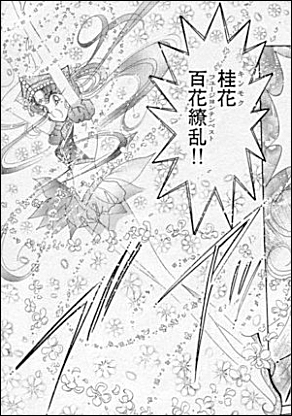
Kaky performs her
Kinmoku Fusion Tempest maneuver in volume eighteen
7. (The name of the maneuver also shows that the
sei in
Kinmoku-sei is not permanent.) The katakana characters that are used to write the name appear next to the kanji


 .
. The first two kanji,

, are used in China to represent the scientific name
Osmanthus fragrans8. The Chinese reading (intended pronunciation) of those kanji is
Guìhu, but the Japanese reading is
Keika. (The other four kanji,
hyakka ryran, mean
many flowers blooming in profusion9.) The kanji
Tankei represent the name of
Kaky’s Kingdom. Those kanji also refer to
Dnguì, which is the Chinese name of the tree that the Japanese call
Kinmokusei.
The olive family of trees and shrubs has the scientific name Oleaceae. Chinese botanists often use the kanji  to represent the scientific name10. The Chinese reading of those kanji is Mùx
 k. Japanese botanists use the term
  Mokuseika to represent the name Oleaceae11.
A variety of fragrant olive trees with silver-white flowers has the Japanese name Ginmokusei12. The Chinese name of the tree is  YÃnguì13. Its scientific name is Osmanthus fragrans variation latifolius (“wide-leaved fragrant olive”). A variety of fragrant olive trees with gold-orange flowers has the Japanese name
  Usugimokusei14. (The usugi part looks sort of like the name Usagi!). The Chinese name of that tree is
  Jnguì15. Its scientific name is Osmanthus fragrans variation thunbergii (“fragrant olive of Thunberg”).

© 2002-2008 Ian Andreas Miller. All rights reserved. Those statements refer to all of the original content on these Web pages. All of the other works that are mentioned on these pages are the properties of their authors.