in the Manga
Let's see how  is used in the Bish
 jo Senshi S
 r
r M
M n manga and anime. Here are the three different possible interpretations of :
- Amazoness, which comes from "Amazon + -ess." This term supposedly refers to only one individual.
- Amazonesses, the plural of "Amazoness." This is one possible interpretation of because plurality isn't usually indicated in Japanese.
- Amazones ( ), which in Greek means "Amazons," is synonymous with the amazons from Greek mythology or the Amazon women in South America.
The manga references of will first be analyzed. To be fair, we'll only consider how is used outside of 
 Amazonesu Karutetto, the collective name for the girls.
The first example appears in act 39, which is quite late in the Dead Moon series of the manga. Alex Glover translates the particular passage as:
1. "We are the strongest soldiers of Amazon legend!" says Jun-Jun. "We carry Amazoness blood!
The Japanese script is "Amazonesu no chi o hiku." The "no" is the possessive particle. However, "chi o hiku" is a Japanese phrase that means "to be descended from." Going by the rules of Japanese grammar, the sentence is saying, "We are descended from the []."
Let's put the three possible interpretations to the test and see how well they work in that sentence.
a. "We are descended from the Amazoness."
In this case, the "Amazoness" is supposedly singular. According to this interpretation, the girls are descended from a person named "Amazoness." The problem is that the characters don't attempt to explain why there's an extra "-ess" at the end of "Amazon." If this "Amazoness" is supposed to be a person, then that person, by defintion, is a woman. What's the purpose of that extra suffix?
b. "We are descended from the Amazonesses."
In this case, the "Amazonesses" is supposedly plural. This interpretation indicates that the girls are descended from a group of people called "Amazonesses." However, "Amazonesses" doesn't explain the "-ess" at the end of "Amazon." If these "Amazonesses" are supposed to be people, then they would have to be, by definition, female. Why is it necessary to add that suffix if the Amazons are already female?
c. "We are descended from the Amazones."
In this case, Amazones is supposed to be plural and it means the same thing as the English word "Amazons." This interpretation fits and there's no extra suffix that needs to be explained.
So, Amazones seems to not only make the sentence make sense, it doesn't seem to leave anything else that needs explaining.
The next sentence from the manga also comes from act 39:
2. passed down by to us by the [].
Here, we've already been told that the "Amazon" in "Amazon Stone" refers to not the women, but to the Amazon in South America.
The full Japanese text says, "Soshite, warera ga Amazonesu ni tsutawaru." Ignoring for the moment, the other words can be translated as, "And, handed down to us by the []."
Let's again try the three possible interpretations of .
a. "And, handed down to us by the Amazoness."
This interpretation also doesn't explain why there's an "ess" in "Amazoness."
b. "And, handed down to us by the Amazonesses."
"Amazonesses" is supposed to be plural. Those Amazon Stones were supposedly given to the girls by people who were called collectively "Amazonesses." However, the characters still don't explain the suffix.
c. "And, handed down to us by the "Amazones." (That is to say, "And handed down to us by the Amazons.")
This one seems to work. According to this interpretation, the girls' treasures were passed down by a line of women called collectively Amazones.
So, Amazones seems to not only make the sentence make sense, it doesn't seem to leave anything else that needs explaining.
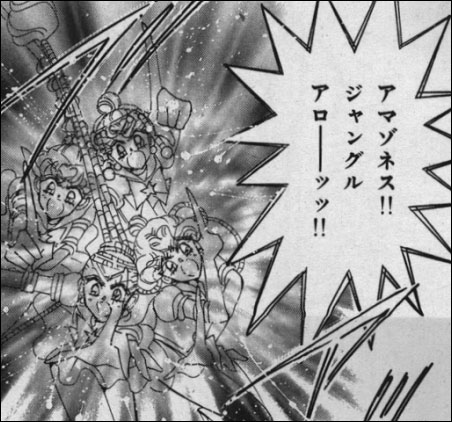
In Bishjo Senshi Sr Mn manga volume eighteen, act forty-nine, page 24, the Sailor Quartetto (the name that is used to refer to the four girls when they're in their sailor soldier forms) perform a special maneuver to defeat Sailor Heavy Metal Papillon. This is what the girls say:
Japanese text: 
Romanization: Amazonesu!! Janguru Ar!!
English Translation: !! Jungle Arrow!
Let us now try each of the three interpretations of and determine which makes the most sense.
a. Amazoness!! Jungle Arrow!!
There are four people involved, and "Amazoness" is supposed to be singular. If they meant to say "Amazoness," which one of the four are they talking about? There's no way to know for sure. Besides, this interpretation still needs to explain why there's an "-ess" at the end of the word "amazon."
b. Amazonesses!! Jungle Arrow!!
Since "Amazonesses" represents more than one of the four girls, this interpretation seems to make sense. However, these four characters still don't give any hints as to why there should be a "-ess" at the end of "amazon."
c. Amazones!! Jungle Arrow!! (That is to say, Amazons!! Jungle Arrow!!)
Amazones refers to more than one of the girls, so it fits. wouldn't be referring to the Amazon Jungle itself because:
- The characters haven't used to refer to the Amazon at any other point in the manga.
- There is no "Amazoness Jungle" or "Amazones Jungle." It's river and the surrounding area (including the jungle) is called the Amazon in both English and Japanese.
- In the past, when the girls meant to refer to the Amazon Jungle, they didn't call it the Jungle. They used a different Japanese phrase in act thirty-nine.
Those are the only three times is used outside of the name in the manga. The Amazones and "Amazonesses" seem to explain the data but Amazones, since it doesn't have anything else to explain when it's used, is the most parsimonious of the two.

© 2001-2008 Ian Andreas Miller. All rights reserved. Those statements refer to all of the original content on these Web pages. All of the other works that are mentioned on these pages are the properties of their authors.