Ian Andreas Miller. 30 September 2000.
Section One of Four
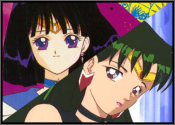 An overwhelmingly large number of fans of the anime and manga
series Pretty Soldier Sailor Moon have problems understanding the themes of
Sailor Saturn and Sailor Pluto. Why is Sailor Saturn associated with ruin? Why
is Sailor Pluto associated with time and space? Some have stated that Naoko
Takeuchi, the creator of Sailor Moon, deliberately switched the themes of these
two characters. Others claim that Takeuchi made a mistake when she created her
characters. Unfortunately, there's the notion that many of the themes from Sailor
Moon are based exclusively on Greco-Roman mythology. This is not necessarily true. The
truth is that Ms. Takeuchi used mythology and astrology (specifically Western astrology
and Eastern astrology) as inspiration. She borrowed many of the ideas and themes
from these two sources and worked them into her story. Those who truly understand
Greco-Roman mythology, Eastern and Western astrology, and the information pertaining
to Sailor Moon should know why Sailor Saturn and Sailor Pluto are fine the way they are.
It would be pertinent to look individually at these two characters and see how well their
themes and associations fit mythologically and astrologically.
An overwhelmingly large number of fans of the anime and manga
series Pretty Soldier Sailor Moon have problems understanding the themes of
Sailor Saturn and Sailor Pluto. Why is Sailor Saturn associated with ruin? Why
is Sailor Pluto associated with time and space? Some have stated that Naoko
Takeuchi, the creator of Sailor Moon, deliberately switched the themes of these
two characters. Others claim that Takeuchi made a mistake when she created her
characters. Unfortunately, there's the notion that many of the themes from Sailor
Moon are based exclusively on Greco-Roman mythology. This is not necessarily true. The
truth is that Ms. Takeuchi used mythology and astrology (specifically Western astrology
and Eastern astrology) as inspiration. She borrowed many of the ideas and themes
from these two sources and worked them into her story. Those who truly understand
Greco-Roman mythology, Eastern and Western astrology, and the information pertaining
to Sailor Moon should know why Sailor Saturn and Sailor Pluto are fine the way they are.
It would be pertinent to look individually at these two characters and see how well their
themes and associations fit mythologically and astrologically.
Sailor Saturn and Her Epithets
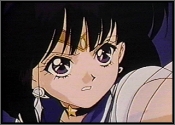 Sailor Saturn
(
Sailor Saturn
( ) has been
called the
chinmoku no senshi
(
) has been
called the
chinmoku no senshi
( ),
which means "soldier of silence," in the Materials Collection. Her most common epithet
is hametsu to
tanj
),
which means "soldier of silence," in the Materials Collection. Her most common epithet
is hametsu to
tanj no senshi
(
no senshi
( )
which means "soldier of ruin and birth." Other characters refer to her as the
horobi no senshi
(
)
which means "soldier of ruin and birth." Other characters refer to her as the
horobi no senshi
( )
and the hametsu no senshi
(
)
and the hametsu no senshi
( )
which both mean "soldier of destruction." The Japanese word hametsu can mean
both "ruin" or "destruction." Never in the anime or manga is
she called the shi to saisei no senshi
(
)
which both mean "soldier of destruction." The Japanese word hametsu can mean
both "ruin" or "destruction." Never in the anime or manga is
she called the shi to saisei no senshi
( )
which means "soldier of death and rebirth," but her powers suggest the ideas of death
as the result of ruin. Incidentally, in the Infinite cycle of the manga,
Sailor Saturn makes it clear that she, herself, will not be the one who restores
the devastated world. When She says "Along with death, there is always hope and
rebirth. You will cause that, Super Sailor Moon." She brought down the Silence Glaive
to end the world, but it is Super Sailor Moon's job to bring the world back to life.
The only time that Sailor Saturn's powers suggests the concept of "rebirth" is when
she performs Death Reborn Revolution to attack Master Pharaoh 90. The
Kanji
(
)
which means "soldier of death and rebirth," but her powers suggest the ideas of death
as the result of ruin. Incidentally, in the Infinite cycle of the manga,
Sailor Saturn makes it clear that she, herself, will not be the one who restores
the devastated world. When She says "Along with death, there is always hope and
rebirth. You will cause that, Super Sailor Moon." She brought down the Silence Glaive
to end the world, but it is Super Sailor Moon's job to bring the world back to life.
The only time that Sailor Saturn's powers suggests the concept of "rebirth" is when
she performs Death Reborn Revolution to attack Master Pharaoh 90. The
Kanji
( )
associated with the words written in Japanese mean "death world revolution" or "death world change." The word
in question is, of course, "reborn" which is the adjective form of the word "rebirth."
Contrary to popular belief, this maneuver doesn't actually bring ruin to the
world in the manga storyline. Sailor Uranus and her comrades explicitly state that
the world doesn't end until Sailor Saturn has "brought down her Silence Glaive." The
point is that, according to the anime and manga, Sailor Saturn's powers mainly have
to do with silence and destruction. On the other hand, Sailor Saturn's Silence Glaive
is often referred to as the chinmoku no kama
(
)
associated with the words written in Japanese mean "death world revolution" or "death world change." The word
in question is, of course, "reborn" which is the adjective form of the word "rebirth."
Contrary to popular belief, this maneuver doesn't actually bring ruin to the
world in the manga storyline. Sailor Uranus and her comrades explicitly state that
the world doesn't end until Sailor Saturn has "brought down her Silence Glaive." The
point is that, according to the anime and manga, Sailor Saturn's powers mainly have
to do with silence and destruction. On the other hand, Sailor Saturn's Silence Glaive
is often referred to as the chinmoku no kama
( )
which means "scythe of silence."
)
which means "scythe of silence."
The Ancient Roman Deity Saturn
The reference to
the "scythe" or "sickle" should bring to mind the ancient
Italian agricultural and blight deity named Saturnus, better known as Saturn.
Saturn's name means "the sower" and he was basically an abstraction that represented
the harvest and its destruction. From what we know, he was Etruscan, not necessarily
Roman, in origin. If a person was a farmer who lived in or around Rome in the fifth
century BC, and his crops were being destroyed by pests or diseases, Saturn would be a
god to whom he might wish to pray. Moreover, at around that time (fifth century BC),
the Romans noticed that the wars between themselves and other Italian tribes had
a devastating effect on agriculture. They established the festival called the Saturnalia
and a temple in honor of Saturn.

© 2000-2008 Ian Andreas Miller. All rights reserved. Those statements refer to all of the original content on these Web pages. All of the other works that are mentioned on these pages are the properties of their authors.