Ian Andreas Miller. 30 January 2003.
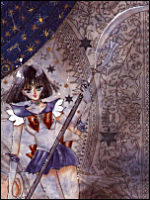
Sailor Saturn, the sailor soldier of ruin and birth, carries the distinctive bladed weapon that the characters refer to as the Silence Glaive. The weapon has become part of her iconography, and most canonical images of Sailor Saturn show it, too. The Silence Glaive, according to the anime and manga sources, contains enough power to destroy a planet. When Sailor Saturn brings down her Silence Glaive in a certain way, she can unleash her world-destroying powers. We know now what the power of her weapon can do, but some fans have wondered about its name. What is a glaive? Why does it have the name Silence Glaive? Should we really be calling the weapon the Silence Grave, instead? This article attempts to provide satisfactory answers to those questions.
What is a glaive? Dictionary.com
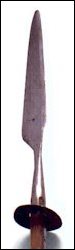
1 cites two different dictionaries that define the term. According to one of those dictionaries, a glaive is “A sword, especially a broadsword.” Another dictionary defines the term as “A weapon formerly used, consisting of a large blade fixed on the end of a pole, whose edge was on the outside curve; also, a light lance with a long sharp-pointed head.” That same dictionary also states that a glaive is “A sword; -- used poetically and loosely.” The term evidently refers to a specific weapon, and it refers poetically or generically to a sword. A certain source that describes weapons, fencing, and fighting methods states that a glaive is a “Polearm fitted with a long, single-edged cutting blade, originating from the scythe (having its blade turned 90 degrees)”
2. Medieval soldiers apparently used the weapon quite often. The foot soldiers were usually peasants who fought along with their lords
3. It should not be difficult to see the connection between the weapons that the peasants used in war and the objects they used for farming. People long ago probably modified farming instruments into weapons.
Sailor Saturn’s association with silence derives from the planet Saturn’s astrological connections with gloominess and taciturnity (habitual silence). (The term
saturnine, which derives from the name Saturnus, means
taciturn or
melancholy7.) Her association with the scythe derives from the mythological scythe that the Grecian Cronus and the Roman Saturn wielded
8. (The Grim Reaper, whose image evidently derives from those two deities, carried a scythe and personified death.) The Greek poet Hesiod composed the poem
The Theogony, which contains the story of how Cronus castrated his father Uranus. Hesiod used the term
drepanon ( )
) in his poem to refer to the scythe
9. That Greek term can also refer to a curved sword or a pruning-knife
10. Incidentally, some English writers use the term glaive loosely or poetically to refer to a sword. Those two terms apparently can have similar meanings.
In short, the first part of the name Silence Glaive relates to the astrological significance of the planet Saturn. Moreover, the second part of the name Silence Glaive corresponds to the scythe, which relates to the deities Cronus and Saturn.




 jo Senshi
  r
r
 n
n

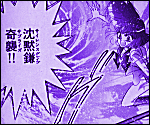
 Chinmoku no Kama) to refer to Sailor Saturn’s weapon

 Sairensu Gureibu) appear over the kanji
  Sairensu Gureibu Sapuraizu) also appear above the kanji combination
  chinmoku kama